Tuesday, November 21, 2006

Connotea tag:evolution citation report

What is a scientific journal ? One possible definition could be - a content provider that filters and selects scientific content appropriate (of interest) to a particular group of people. Currently, journals select papers based on the decisions of a small group of people, maybe one or two editors supported by a few referees. The internet allows for alternative methods to select and filter content based potentially on the knowledge of a larger group of people. Eventually, these methods might one day replace the expansive editorial procedures now in place in most journals, but before that happens these approaches have to be evaluated. Also, even if we don't use these methods to replace current editorial procedures, they can be used to help us highlight the most interesting works published in certain fields.

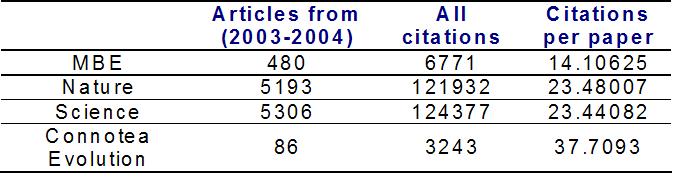
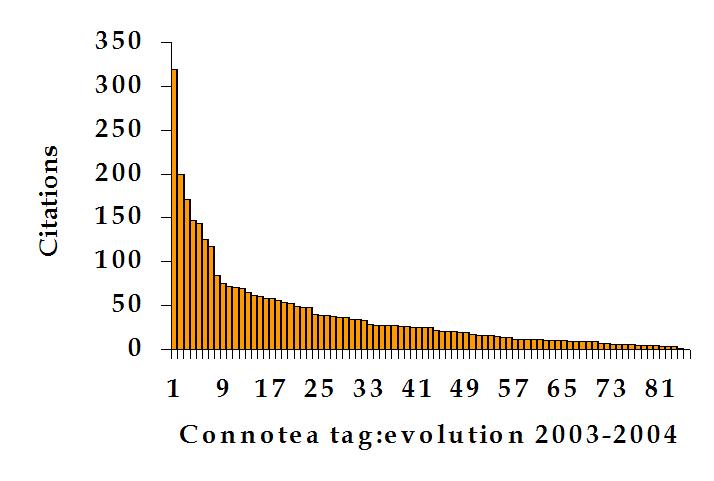
So, why not consider tags in social bookmarking services like Connotea as scientific journals ? Here is the journal Connotea tag:evolution. I took from Connotea yesterday (21/11/2006) all papers tagged with the tag "evolution" , that were published in 2003 or 2004 (85 papers). I used the web of science to get the number of citations of each of these papers (see figure below). This was unfortunately done one by one. I am thinking of scripting some tool to do it automatically but if someone knows a better way please let me know.

As expected the most represented journals are some of the journals with higher visibility but still more than 50% of the manuscripts were tagged from more specialized journals.

So how does the average number of citations per paper of this "new journal" compare with well established journals ?

Although Connotea Evolution is low volume compared to other journals it does have a higher average citation per paper than journals such as Nature and Science. I did not separate potential non citable items from any of the groups so it should be a reasonable fair comparison.

I think this suggests that we should evaluate potential mechanism to guide us to interesting scientific content. By itself, these evaluations might establish a form of reward for the community to come up with more sophisticated tools. It is important therefore to carefully pick the measurements. I used the citations per paper but others might be more adequate.

Any group of people can use the internet to re-group scientific content (specially if it is open access) into "journals" of potentially more value than those currently available.

Monday, November 20, 2006

Journals Proliferate

I only noticed today BMC also had a Systems Biology journal. There are no papers yet but the editorial board looks interesting enough. From the types of articles they expect I think they will take a lot of bioinformatics related manuscripts. This adds to two other Systems Biology journals that I am aware of: Molecular Systems Biology (also open access) and IET Systems Biology.

(via BioHacking) On a more creative note, here is the Journal of Visualized Experiments. It is a "journal" of recorded experiments that should help others learn protocols with the aid of videos. Currently the submissions are subjected only to editorial evaluation and are expected to get published in about 14 days. They plan to apply for listing in PubMed and other databases.
The videos are accompanied by a very short written explanation and are tagged for searching. There are no comments or RSS features that I could see.

Nature Methods and Nature Protocols should give this a try. By the way, Nature Protocols also publishes protocols in bioinformatics, and Nature Methods started a blog (Methagora)

With this continuing expansion of journals in all publishing houses aren't we quickly reaching a point when manuscripts will be the scarce resource ? I really hope someone develops nicer tools to suggest communications to read based on my interests. Is there a place for researchers whose job is just to associate and shuttle communications around ? Tagging communications as FOR_SMITH_J to show up in some reader with a comment: "solves your problem X".

Chris Surridge explains PLoS ONE


As part of the OpenWetWare's Seminar Series on Open Science, here is Chris Surridge explaining PLoS ONE. Some random things I remember:
- No-one reads full table of contents anymore so why not create a journal with broad scope ? (I do read full table of contents of many journals, it's the first thing I do in the morning)
- They are aiming at a very high volume (hundreds of manuscripts)
- The journal will probably have portals for subject areas
- Anyone is free to reuse the open access content, so anyone could in theory be an editor by reusing open access content and focusing it for a particular target audience.
- They might also pool in papers from other open access journals
- There will be probably a karma system to rate the contributions
- The system of having different versions of the same manuscript will not be on the first version of the journal.
- The journal might be up on the 29th of this month (not sure yet)
- Chris Surridge moves around too much :)


Tuesday, November 14, 2006

iTOL - Interactive Tree Of Life

The Bork group published recently a revised tree of life in Science. You can have a better look at the tree using this nice interactive tree viewer that they put up on the web (publication).


You can zoom in and out, re-root, swap branches, and export the trees. You can also upload your own trees and annotations to have them drawn by the viewer. Hovering over the species brings up a box with some information. Did you ever wonder who donated DNA for the human sequencing project ? The Bork group has found out for us:

Monday, November 13, 2006

PLoS redesigns, PLoS ONE soon

Go have a look at the PLoS websites, they have been redesigned. I like the look but the only notable changes are a box "From the Blogosphere" that currently links to the Open Access News blog (I wonder why:) and a link to "Readers Respond" on the left, that should put more emphasis on user participation. The PLoS Medicine site has some notable differences. First they include the PLoS Medicine blog on the home page and the "From the Blogosphere" links to a Guardian article. I guess that these are customizable and left to the editors to use to point out interesting things related to the journal or field. Now ... when will PLoS Comp Bio start a blog ?
Still no journal is taking in blog comments. It would be easy to use Postgenomic's index or trackbacks to let readers comments papers trough their blogs.

There is also an editorial in PLoS Biology about PLoS ONE: "ONE for All: The Next Step for PLoS"
The only new thing I got from the editorial was the concept of portals withing PLoS ONE. I would say it sounds a bit like the Nature Gateways, an area for the aggregation of papers and other resources related to a particular field or project. Sounds like a good idea. Again, they mention that at the start it will look like any other journal and that they will build on it in time, so I don't expect much in the launch day.

Bio::Blogs#6 @ Nodalpoint

Greg has volunteered to host the 6th edition of Bio:Blogs at Nodalpoint (half a year already). It should take place on the 1st of December. Anyone that wants to participate just has to point out an interesting bioinformatics related blog post by email to the usual bioblogs _at_ gmail _dot_ com.

Some links:
(via postgenomic and Clinical Cases and Images) The Lancet started a blog (creatively called The Lancet blog) . If it funny that some of the oldest journals are testing new ideas in publishing leaving some of the more recent ones lagging behind.

Here is another bioinformatics related blog. From a research associate at Newcastle University, interested in neuroscience.

Friday, November 10, 2006

MeeboMe to

Fallowing the tip from Deepak I decided to give MeeboMe a try here in the blog.
Fell free to interrupt my thesis writing :) by writing something there on the box.

Thursday, November 09, 2006

Personal fabrication - Update

Several years ago I read a book by Nicholas Negroponte entitled "Being Digital". It was a really great introduction to the digital revolution and provided with a glimpse to some of the changes that are still ongoing in our society. I find fascinating the ability that some technologies have to change so much our ways of living, opening up with a simple stroke so many new possibilities. The digital revolution was one of these events. An apparently simple concept of having information coded in a digital format that can be transported anywhere at near instantaneous speeds. Now we have the internet that as provided with so many wonderful advantages. I can learn anything I want, provided I have time. I can collaborate with people I have never even met before to build new things. It is difficult even for me to imagine living in an unwired world (but that might be a bit geeky thing to say :).

I read today this profile on Neil Gershenfeld and his work on home manufacturing at MIT and I though that this would also be a very empowering technology. He is pushing the concept of personal fabrication, enabling anyone to easily create any physical thing. He wants to bring the same speed to making atoms that we have today for bits. You could grab a funny chair design that you made in your computer, send it to your friends by email and they would open it .. very literally by "printing" it and sitting on it to try it out.
I guess there are lots of details to think about, but generally the idea sounds fun.

I was thinking that some companies should have a go at this already. I am not really into design but I guess that several companies today focus on constantly renewing their stock with new designs and trend setting ideas. Why not have an Ikea section of "do your own" furniture. Something like social web manufacturing of clothes, accessories, furniture, etc.

Also, why not have collection of the most used objects in Second Life, built every quarter or half a year. Second Life authors would have to agree and probably negotiate a cut of the profit.
Here is someone building a guitar :)

Where is the print button to get one of those right now?

Update:
I am really behind on this meme. I few more clicks and I found this blog post in MIT Advertising lab. From there I found this company that specializes in bringing virtual objects to life.

A blog post by Ian Hughes on home fabrication.
A wiki page fab@home with instructions to make "fabbers", machines that can make almost anything, right on your desktop.

Sunday, November 05, 2006

Activating RNAs (RNAa) - another twist

A paper published online in PNAS described a possible new form of regulation of gene expression by small RNAs. The authors found that small dsRNAs can also serve as transcriptional activators. They showed that the mechanism for gene expression activation also prefers dsRNAs of ~21 nt in size and requires the Argonaute 2 protein.

The story was covered by a news article in Science. From the news article it looks like there is some fear that the result might be due to indirect effects (inactivation of other genes leading to gene expression activation). Also, some wonder why this as not been picked up before by other studies.

I am very tempted right now to get some of the high-throughput screens of RNAi to try dig out some more examples that might have gone unnoticed (if I actually had any time to do it :).

Wednesday, November 01, 2006

Bio::Blogs#5

The November edition of our bioinformatics blog journal is up at Chris' blog. This edition is mostly focused on potencially interesting tools to use, including Zotero, a bibliography manager Firefox extension and Bioclipse, an open-source workbench for bio/chemi-informatics.

I forgot to ask Chris to link to the bio::blogs icon challenge. I guess we can run it for another month. If you don't like these two icons and you think you can do better give it a try :) until next month.

We are in need of a volunteer to host the December edition. If you run a bioinformatics related blog and are interested send in a link to your blog to bioblogs at gmail.com or leave a comment below.

Monday, October 30, 2006

Networks in the sky: a new concept of modularity?

A recent paper by Batada and colleagues published in PLoS Biology tries to consolidate the available information on protein-protein interactions for S. cerevisiae. The authors have attempted to create a high-confidence set of interactions that they then further analyze. The main conclusion from the paper is that the highly connected proteins (usually referred to as protein hubs) do not avoid each other, as was previously put forward by other authors. From this observation they suggest that we should rethink our view of modularity in cellular networks. Cellular interaction networks should be viewed, not as altocumulus clouds, “i.e., cotton ball-like structures sparsely connected by thin wisps”, but instead as the “continuous dense aggregations of stratus clouds”.

Although I find it useful to constantly update our view of cellular networks trough the consolidation of available data, I think some words of caution remained unsaid in this work.

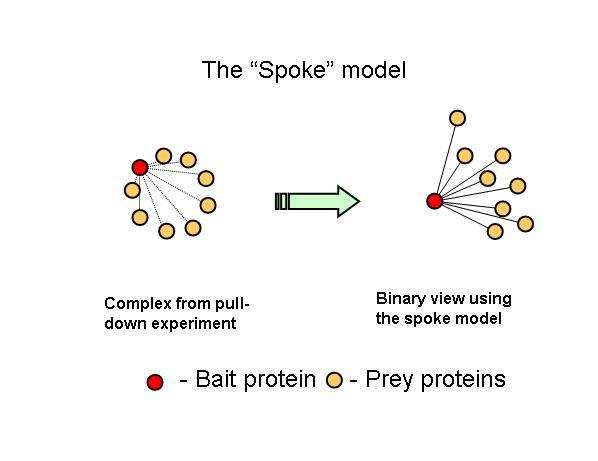
The new consolidated protein interaction network was obtained mainly from the addition of a recent curation effort from the literature, to the already available high throughput interaction datasets obtained using yeast-two-hybrid and affinity methods. The majority of the interactions added are from affinity methods. This leads me to one of points I think are not usually mentioned in this type of efforts, that not all methods will provide the same information. For example, I think that affinity methods mostly inform us that two proteins share the same complex. When a protein is tagged and used as a bait to capture prey proteins, the identified preys should belong to the same complex but it is not obvious that there should be a direct interaction between the two. However this was the assumption used here in this work. This is usually referred to as the spoke model (see figure 1).

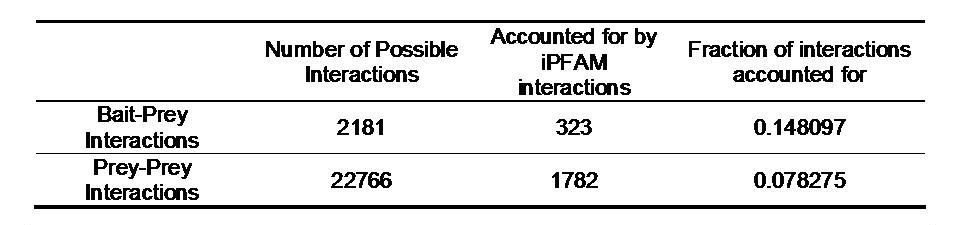
I have tried to evaluate how likely are bait-prey interactions to occur, when compared to prey-prey interactions, using either structural information or yeast-two-hybrid interaction data (see table 1 and table 2).
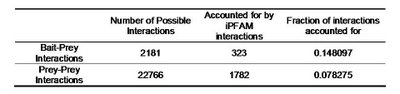
Table 1 – Pull down experiments were taken from Gavin et al, 2002. For each individually reported pull down, potential bait-prey and prey-prey interactions were counted if the corresponding proteins had known PFAM domains. Using the database of domain structural interactions (iPFAM), I tried to search for plausible domain-domain interactions that could account for the protein interaction. Bait-prey interactions are roughly 2 times more likely to be explainable by a known domain-domain interactions currently stored in structural databases, than prey-prey interactions.
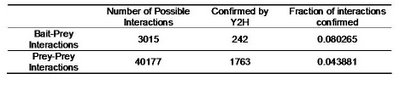
Table 2 – Pull down experiments were taken from Gavin et al, 2002. For each individually reported pull down, potential bait-prey and prey-prey interactions were counted. The overlap of these interactions with known yeast-two-hybrid interactions is shown. Bait-prey interactions are roughly 2 times more likely to be observed in a yeast-two-hybrid study than prey-prey interactions.

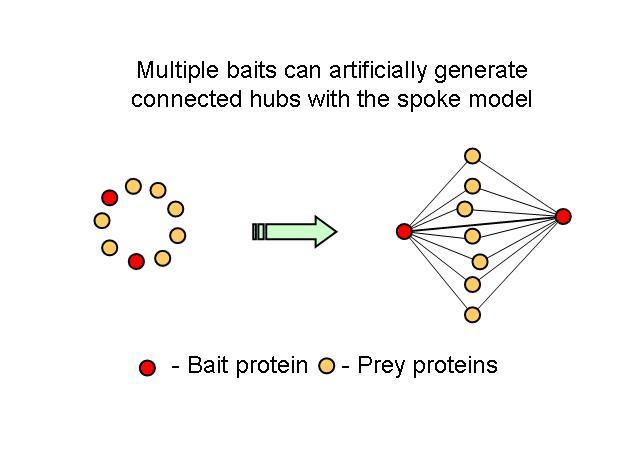
What one could conclude from this is that in fact bait-prey interactions are more likely to occur than prey-prey interactions but also that a small percentage of the bait-prey interactions can be validated with a method that is more likely to measure direct interactions. Using both domain-domain structural information and yeast-two-hybrid studies, 20% of the bait-prey interactions can be accounted for. Although this value depends on our current knowledge of domain-domain interactions and the coverage of yeast-two-hybrid studied it should at least be discussed. One problem in using this model can be for example seen in figure two. When multiple baits are used for the same complex, it is easy to create artificially interacting hubs, when extrapolating binary interactions from affinity data.
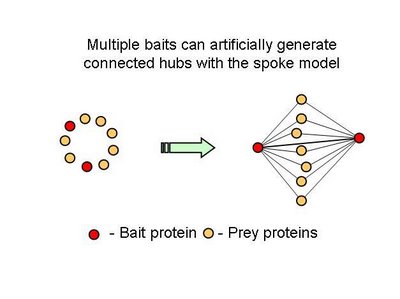
In all fairness, in this study, the authors only took as a true interaction, one that was observed more than once but they also consider multiple affinity observations as confirming a direct interaction. It would be useful to come up with better methods to extrapolate from complexes to binary interactions. I hope the differences observed in this work regarding hub-hub interactions are not mainly due to the proportion of interactions extrapolated from affinity methods.

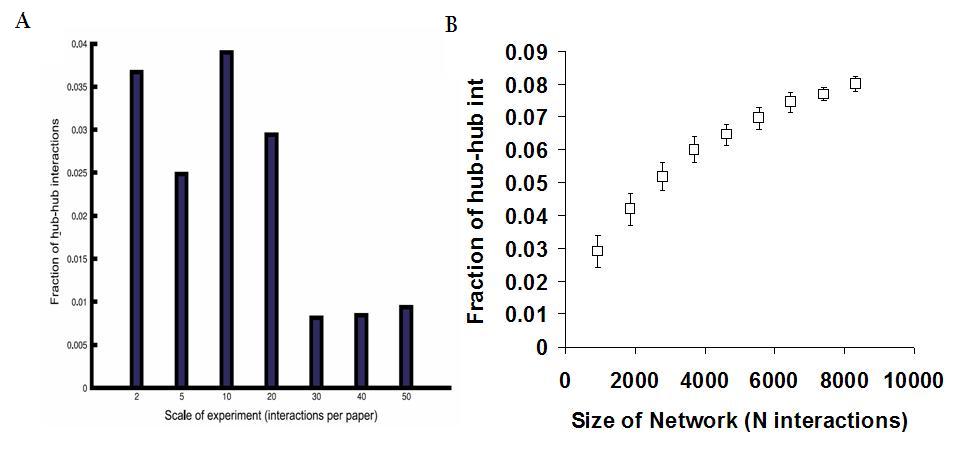
One observation that the authors used to support their claims was that, apparently, the fraction of hub-hub interactions depends on the scale of the experiment (see figure 3A taken from the authors paper). According to this result, experiments reporting higher number of interactions tend to have a lower fraction of hub-hub interactions. Hubs were defined, in the figure legend, as the 10% more connected proteins in the network, but in the results description are defined as the 5% more connected proteins. One thing that the authors failed to show is how this fraction of hub-hub interactions depends just on the size of the network. I have used the network given in the manuscript and randomly sampled 10% to 90% of the interactions (repeated 50 times) to plot the dependence of the fraction of hub-hub interactions on network size (see figure 3B). Hubs were defined as the 5% more connected proteins.

What we can see is that the fraction of hub-hub interactions depends on the size of the network, decreasing for smaller network sizes. Can this explain the result observed by the authors? In figure 3A, taken from the authors’ paper, the whole network was binned by the number of interactions reported per paper. I have tried to calculate the size of different networks obtained from binning according to the scale of the experiment (see table 3).

I would say that, although I could not reproduce exactly the same bins reported in the paper, the trend is for a decrease of network size when comparing all interactions reported in small-scale studies to those reported in medium-scale experiments. Therefore I think the observed result is mostly explained by differences in network size. In fact, if one would take all interactions reported in experiments observing at least 30 interactions the fraction of hub-hub interactions observed would be even higher than in the network obtained from very small scale experiments.

Summary
I think this manuscript highlights that we should constantly re-evaluate our views on cellular networks as more data is made available. Although the concerns raised here do not contradict their conclusions I think they should have been more carefully discussed. In particular I think we require better methods to extrapolate binary interactions from affinity methods and that it is important to mention that this might lead to false positive interactions. Also, there is a strong effect of network size on the observed fraction of hub-hub interactions. This might explain both the observed increase of hub-hub interactions with increase in the coverage and the observed dependence of the fraction of hub-hub interactions on the scale of the experiment.
Thursday, October 26, 2006

I googled from Yahoo too

There are some google people going nuts over at the official Google blog. They don't want us common mortals to use the word Google as a verb when searching trough something other than their website. That is a very good away to attract some negative feelings.

While we're pleased that so many people think of us when they think of searching the web, let's face it, we do have a brand to protect, so we'd like to make clear that you should please only use "Google" when you’re actually referring to Google Inc. and our services.

So, let me say how much I like to google from Firefox for example. I actually google in Firefox most everything. When I don't google from firefox I google from my taksbar. Right now both are set to actually google in Google, but many more nice blog posts like this one and I migh actually give Live search another try.

Wednesday, October 25, 2006

Focus on Systems Biology: a User's Guide

Nature Cell Biology and Nature Reviews Molecular Cell Biology are jointly producing a Focus on Systems Biology: a User's Guide. It contains several reviews on the topics related to data management, bioinformatics and modelling (probably sub only)


PLoS ONE - Spread the Word

PLoS ONE will soon make its debut. They seem to be going strong with 210 submissions since the initial launch on the 4th of August. Last week alone they got 30 papers to review.

According to an email they sent to the mailing list they have now 179 members in the editorial board but they encourage scientists from areas that are not yet well covered in the PLoS ONE editorial board to work with the journal.

They have also added some goodies to download for anyone interested in spreading the word. Grab a flyer, print it and post it up on your work place :)

PLoS ONE - www.plosone.org

Sunday, October 22, 2006

Bio::Blogs icon entry

Here is an icon made by Rick from My Biotech Life:

I really like how he managed to fit the "bioinformatics blog journal" on top of bio::blogs. He is right that it is a bit big for an icon but it looks really great :). Thanks for the effort.
I guess we can keep the challenge open until the end of the month and then choose one during the edition. If anyone wants to submit an entry by email send it to bioblogs _at_ gmail.com.
Recently added feeds - more science bloggers

The blog of Jonathan Eisen, an evolutionary biologist and a Professor at U. C. Davis (Eisen lab at OpenWetWare).

The blog of Marc Gerstein, Prof. Biomedical Informatics at Yale (lab site)

(via mndoci) The Omics World, a blog about : "Genomics, life science technology , computational biology , structural biology and their inter-relationships"

Wednesday, October 18, 2006

Changing scientific publishing

There was a panel discussion about the future of scientific publishing in the Neuroscience 2006 conference. Sandra Aamodt of Nature's Action Potencial blog, Jake Young from Pure Pedantry and Dave Munger from Cognitive Daily have blogged their thoughts on what was talked about.

There are two main points under discussion. One is how can the publishers make the switch to an open access model (where all the content is available) in a sustainable way. My impression from what I read and from talking to other people is that a lot of the publishers are or will be experimenting with open access options and if the demand is high enough this will be the direction they will go for.

The other big discussion is how to transition to the web, taking advantage of other possible tools that are not available in the print world. This issue is unfortunately much less explored. One of reasons is because they are stuck in the first issue. Another reason is that the people who are in charge of editorial boards are taking some time to realise the potential of the internet. Blogs and wikis for them are something messy and chaotic that teens use.

Is there any science related activities on blogs and wikis ?
- according the September statistics there are about 1500 science related blog posts per week coming from about 200 science blogs register in postgenomic
- postgenomic has gathered comments on about 2500 papers
- there are about 1000 science related blogs registered in Technorati.
- there are more than 1500 scientists helping out to build the OpenWetWare wiki.

I did not try to get numbers from connotea and citeulike but I am sure that are a lot of papers being tagged and rated every day.
Given that the science community as just started to participate online in blogs and wikis I guess the numbers will only increase.

One interesting detail, postgenomic keeps track of the most referenced journals (on indexed blogs) and the top tree are Nature, Science and ArXiv. The third most blogged about "journal" is a repository of manuscripts that have not yet been peer reviewed.

There are all sorts of possible criticism that one can make of these numbers. Technorati numbers are probably inflated with spam blogs and blogs that are not really science related, comments indexed by postgenomic can be anything from one line to a full review, etc. I just wanted to show that there is already a lot of science communication going on in blogs and wikis.

Tuesday, October 17, 2006

Bio::Blogs icon challenge

Bio::Blogs, the bioinformatics blog carnival/journal is going for it's 5th edition. It will be up on the 1st of November on Chris' blog. Maybe we could celebrate by trying to create an icon to represent Bio::Blogs. I quickly stole some ideas (I think from something I saw in Neil's blog :) to make this up:


It should not be difficult to make something better :) Does anyone want to try ?

Saturday, October 14, 2006

The 3rd EMBL Biennial Symposium

One of the nice things about being at EMBL is that we can sneak into the ongoing conferences. This one is entitled: "From functional genomics to systems biology" and today was the first day.

I will just highlight some of the talks that I found most interesting. One was by a group leader here at EMBL, Lars Steinmetz who has been using tilling arrays (microarrays that try to cover the whole genome) in S. cerevisiae to look at the expression of non-coding regions in the genome. Although S. cerevisiae does not have the components for RNA interference, it does seem to have many non coding RNAs that are expressed. Many seem to be antisense to coding genes and also they could identify some of these non coding RNAs that were oscillating in a cell-cycle dependent manner. They are also using this arrays to look at the differences of expression of different strains and to study events of recombination.

The talk that I most enjoyed today was by Alexander van Oudenaarden. His group is studying small cellular circuits and cellular noise. He showed at lot of data on the galactose inducible promoter, detailed in this picture I took from their site :

He showed that the activity of the Gal4 promoter can be in two separable steady states and that this is history dependent. So yeast cells have memory in their metabolic state. He also showed that this state is inherited by the daughter cells and that they can manipulate the systems such that circuit can have a more or less stable memory. Also, not only the state is inherited but even the likelihood that the cells will switch state is also transmitted to the daughter cells. They studied this with flow cytometry to quantify single cell measurements and with microscopy to be able to follow the lineages. All of this was well integrated into predictive models of the system. Extra points for having a webpage on OpenWetWare :)

When will we be at a point were we can actually take high-throughput assays, combine them, make a model of modules that we find and have this detailed understanding of how they work ?

Friday, October 13, 2006

Google Data Privacy - GDP


(via Konrad) I like this idea of having some way to tell Google what data to keep and for how long to keep it. Some one-point access to how much they really know about me :). I don't mind to much that they have this information, but I would like to be able to control it. They even have gotten really good at serving me ads. If it is an ad pointing to something I want to go check out than it's a good ad.
I would go a step further then. I want to own that information. I want to be able to take it somewhere else and share it with other services that might work better if they know these things about me. Amazon would probably suggest more interesting things.

So, I also want a Google Data Privacy.

For more check out AttentionTrust.