Friday, March 16, 2007

Bioinformatic web scraping/mash-ups made easy with kapow

In bioinformatics it is common that we might need to use a web service multiple times. Ideally, whoever built the web service provided a way to automatically query the site via an API. Unfortunately, Lincoln Stein's dream of a bioinformatics nation is still not a reality. When there is no programmable interface available and the underlying database information is not available it's usually necessary to write some code to scape the content from the web service.

In come openKapow, a free tool to (easily) build and publish robots to turn any website into a real web service. To illustrate how easy it is to use it I have built a Kapow robot to get, for any human geneID, a list of orthologs (with species and IDs). I downloaded the robotmaker and tried it on the Ensembl database. To be fair Ensembl is probably one of the best bioinformatics resources with available API and easy data mining tools like Biomart. This was just to give an example.

You start the robot by defining the initial webpage and the service inputs and outputs. I decided to create a REST service that would take an Ensembl gene ID and output pairs of gene ID/species name. The robotmaker application is intuitive to use for anyone with a moderate experience with HTML. The robot is created by setting up the steps that should occur to transform the input into the desired output. For example, we have to define were the input should be entered by clicking on the search box:
From here there are a set of loops and conditional statements that you can include to get the list of orthologs:

We can run through the robot steps with a test input and debug it graphically. Once the robot is running it is possible to host it on the openKapow web page, apparently also free of charge. Here is the link for this simple robot (this link might go down in the future). Of course it is also possible to build new robots that use robots that are published on openKapow. Also this example uses a single webpage but it would be more interesting to use this to mash up different services together.
Systems and Synthetic biology RSS pipe

Here is the RSS feed for a Yahoo pipe combining and filtering papers mostly about synthetic and systems biology. There are three systems biology journals directly combined into the feed. Unfortunately I could not find the RSS feeds for IET Systems Biology so it is not included. On top of these are added selected papers from Nature tittles, PLoS titles, Cell, PNAS, Science and Genome Biology. The filtering is done using some typical key words that might be associated to Systems and Synthetic biology. Here is a simple illustration of how it works:
I still have to test the pipe for some time and tweak the filters, but it is enough to get an idea of the things that can be done with these pipes. Like the pipe before you can clone this and change the filters and journals as you like.
Community filtered journal RSS feeds


I was trying out Yahoo pipes today to see how much we can actually program with it. It has some loop functions and regex filters but otherwise it is currently a bit limited. One thing that it is very good for is to combine and filter RSS feeds. Imagine that you want to get all the papers of a journal (or a group of journals) but only if someone else has for some reason found them interesting. This was what I tried to do with this pipe. I piped the RSS feed for MSB through a Yahoo query restricted to Connotea or Citeulike and in return I get a feed for the papers that have been tagged by other people in these sites. The problem is that this relies on the yahoo search, so it has to wait for yahoo to crawl those sites before it identifies the a new tagged paper and it is also possible that the paper title is to ambiguous and therefore incorrectly matched.

To add/change the input journals copy the pipe from here and edit the top fetch box.
(disclamer: I am currently working for MSB)

Wednesday, March 14, 2007

Quick Links

Deepak recorded his first podcast. Even if I am not a big fan of podcasts, I found it interesting to hear. Maybe it could serve as platform for a radio version of his blog. The idea of doing interviews would be really nice. In general I prefer reading because I can do it much faster than listening. Next year, when I go back to doing more bench work I will probably try consuming podcast while working.

(Via Deepak, Roland, and Konrad) Freebase is a very promising new web service. For those who have heard about semantic web, it will look familiar. They want to organize data by allowing users to add metadata to the information stored on the site. This will be great for aggregation of content and data mining. For science it could serve as place to deposit and organize data for collaborative projects.

(Via BioHacking) Microsoft has announced the winners of the first award for computational challenges in Synthetic Biology. Six projects were awarded a total of $570,000 (USD) to develop tools for synthetic biology.

(Via Jason Stajich) My own favorite model organism database (SGD) has created a wiki for community annotation. Anyone interested in S. cerevisiae biology, methods, reagents and strains can go there and help populate the wiki.

Tuesday, March 13, 2007

Global Ocean Sampling Expedition - Update

(via Konrad and Jonathan Eisen) The first results of Craig Venter's boat trip are now packaged and presented in PLoS Biology. There is going to be a webcast today at 10:00 AM Eastern time, 15:00 GMT. I am still skeptic of the usefulness of such datasets. Right now I still think that metagenomics, with current analysis methods, looks more promising at a smaller scale, to analyze smaller bacterial communities were the impact of perturbing the bacterial community could be studied. Of course this can be just my naive view of someone that never actually did any work with these datasets. In any case, many groups are likely throwing a lot of computing power at making many more interesting findings from the data. Also, this is just the first part of the trip. The full voyage can be seen in their website. I wonder what they will do with the rest of the data.

Any concrete questions on metagenomics can be directed at the blogs of the experts :). Konrad works with metagenomics in the Bork group and Jonathan Eisen is one of the authors in some of the papers, so he might know a thing or two about this stuff.

Craig Venter might be a controversial figure but he has surely been one of the few that has so strongly generated enthusiasm in science. He has been involved in the sequencing race to finish the human genome draft, a great metagenomics sampling voyage around the world (inspired by the British Challenger expedition) and some initiatives on the personal genome and biofuel production. His actions are propagated in the media and bring biology closer to the people that pay for us to do this work.

(image adapted from Gross L (2007) Untapped Bounty: Sampling the Seas to Survey Microbial Biodiversity. PLoS Biol 5(3): e85 doi:10.1371/journal.pbio.0050085)

Update - The webcast mentioned above has started. It looks like a bit of marketing hype event. The fact that we need windows media player might scare some people away. There is an email address in the site to send in questions. I will try to liveblog it for a while.

14:18 GMT -A PLoS editor is up explaining why open access publication is such a good match to this work.
Many of genome papers are not freely available. Venter decided to publish in PLoS making not only the data but the papers describing them are available.

14:20 GMT - Venter is up again. It took them 6 months of peer review to get the papers trough so we should not confuse open access to easy access. 18 000 40 000 new species after 1 my of sequences from the Sargasso sea. The question was to continue sequencing Sargasso sea or going to other places. This why the the expedition was set up. Part of the motivation for the voyage was also to promote science to the main public. Some of the areas were they passed they had some political problems because they are contested by different countries. There is a very large divergence from site to site (but this we can read in the papers anyway).
He suggest it would be possible to tell were a ship came from by analyzing the microbial diversity in the boat. There is strong geographical preference for the light sensitivity for the foto-receptors. Another surprise was trying to map the diversity obtained in the voyage to known genomes. They could observed co-existence of organism with very large sequence diversity for the same species (not sure I got this right but it is in the main paper). New gene and protein families are being discovered in linear fashion and therefore we are still not near saturation.

14:30 - Introduction of the CAMERA database to host the data. Genomic and environmental on a big cluster, currently doing blasts . There are huge problems with a database of this size so they are (i think) making different copies of the database in the US.

14:40 - Venter is up again to answer Q&A. I'll end the liveblogging here.

Monday, March 12, 2007

Journal policies on picture copyright

When blogging about science papers it is usually very useful to use some of the published pictures. Unfortunately most science publishers still use very restrictive licenses that disallow the use of the published material. In most cases I would be interested in promoting the paper because I think it is interesting and worth spending some time writing a blog post on. Aside from helping me remember the paper by writing down a post it it useful for meta aggregation of opinions (see Postgenomic). Eventually we might get the direct opinion from scientist in each field about what is being published. So, in most cases, it is in the publishers interest that I take a picture from the paper to promote it. What are the journal policies on this issue ?

PLoS and BioMed Central:
These are most blogger friendly publishers, they publish on open licenses that allow the re-use of content including making derivate works as long as there is clear attribution to work. We are even free to make money from this content or from derivatives that we make with it. From a user point of view this is absolutely liberating. I can not only read these manuscripts but I can use their pictures to comment on them and I can even think of creatively combining their content with other works. An example of this is PLoS Two, a site to explore layouts created by Alf based on the content of PLoS ONE. Anyone could try to create a better website for a science journal based on the content of PLoS and BioMed Central.

PNAS:
On their page on Rights and Permissions we can read:
"Anyone may, without requesting permission, use original figures or tables published in PNAS for noncommercial and educational use (i.e., in a review article, in a book that is not for sale) provided that the original source and copyright notice are cited."

It does not really say anything about blogs but I think it would be safe to take a picture from a PNAS paper and blogging about it since I don't run any adds and it would clearly be for educational use.

Science:
When you click on an image in a paper we see below the picture:
"You may download the image(s) above for non-profit educational presentation use only, provided no modifications are made to the content. Any use, publication, or distribution of the image(s) beyond that permitted in the sentence above or beyond that allowed by the "Fair Use" limitations (sections 107 and 108) of the US Copyright law requires the prior written permission of AAAS."

Again, they make no mention of the online world. They are probably talking about using the picture in a public presentation in a conference for example. How would this relate to a blog post? To make sure it would be necessary to send fill out this form asking for permission, but I think it would take some time to get a reply. I will get back to the fair use issue below.

Nature:
In their page on rights and permission they write:
"Permission can be obtained for re-use of portions of material - ranging from a single figure to a whole paper - in books, journals/magazines, newsletters, theses/dissertations, classroom materials/academic course packs, academic conference materials, training materials (including continuing medical education), promotional materials, and web sites. Some permission requests can be granted free of charge, others carry a fee."

So it is possible to get permission to use their content but it has to be obtained on a case by case basis and it might cost money. I tried getting permissions to use pictures from a Nature Biotech paper for a educational website and it cost nothing for 1 to 3 pictures. Above that it starts costing 150 dollars. It also costs nothing to get permission to include less than 400 words but above that we have to pay. The procedure is very straightforward and can be done in a minute.

Oxford Journals (including Bioinformatics)
Permissions of Oxford Journals is handled by the Copyright Clearance Center. We have to request permission also on a case by case basis:
* Simply visit the Oxford Journals homepage and locate the content you wish to reuse by searching, or navigating the journal's archive.
* Click on "Request Permissions" within the table of contents and/or in the "services" section of the article’s abstract to open the following page:
* Select the way you would like to reuse the content
* Create an account or log in to your existing account
* Accept the terms and conditions and permission will be granted

The gave it a try with a bioinformatics paper and at least to get permission to use 1 to 4 pictures on a non-commercial e-book it would not cost anything. There was no option for a blog post but I think it is sufficiently similar to an e-book. Five or more pictures require payment to obtain permission. Again, the procedure is fast and straightforward.


This is not an exhaustive search but overall I think we are safe in using one or two pictures in a blog post (on non commercial blogs) to talk about a paper. Even if there is no clear way of obtaining permission we might able to claim that this is fair use. According to the US copyright law fair use is:
Notwithstanding the provisions of sections 106 and 106A, the fair use of a copyrighted work, including such use by reproduction in copies or phonorecords or by any other means specified by that section, for purposes such as criticism, comment, news reporting, teaching (including multiple copies for classroom use), scholarship, or research, is not an infringement of copyright. In determining whether the use made of a work in any particular case is a fair use the factors to be considered shall include —
(1) the purpose and character of the use, including whether such use is of a commercial nature or is for nonprofit educational purposes;
(2) the nature of the copyrighted work;
(3) the amount and substantiality of the portion used in relation to the copyrighted work as a whole; and
(4) the effect of the use upon the potential market for or value of the copyrighted work.
The fact that a work is unpublished shall not itself bar a finding of fair use if such finding is made upon consideration of all the above factors.

Unfortunately this is absolutely vague but what publisher in their right mind would even try to sue a poor blogger when there might be a case for fair use. According to Postgenomic there has been around 2500 science blog posts a week. Even if only a fraction are talking about actual science papers it would be nice to have clear policies from the publishers on the subject.

Thursday, March 08, 2007

The value of a reader in an author pays publishing model

In many respects the changes in online communication and collaboration have been the leading edge of what latter is tested by the scientific community. I regard sites like Digg, del.icio.us, blogger and other related sites as experiments from witch we can learn about using the internet to make scientific communication and collaboration more efficient. In that context I think there might be an interesting analogy between a study (PDF version), pointed by Nick Carr discussing the value of a free costumer.

In this study the authors created a model to analyze the "profitability of costumers in a networked setting". One example of this type of setting are the auction houses were two distinct users (buyers and sellers) exist. Buyers do not pay anything to the auction houses but provide an obvious value that is, as they say, difficult to quantify. In their analysis they estimated that in this type of network setting the value of buyer is actually higher than the value of the seller (the one that actually pays to use the service).

How might this relate to scientific publishing? In the current model of a journal like PLoS or similar journals there are two very obvious "costumers", the author (that pays to have the article distributed) and the readers, that pay nothing to get access to the journal. The other main publishing model is the opposite, the authors pay nothing (or much less at least) and the readers have to pay to access the journal. It might be that in the different models the publishers might have to direct their efforts differently. In a journal like PLoS ONE were the quality of the service might actually improve with the participation of the readers (annotations/discussions) I would think that the value of the reader is likely much higher than the paying costumer (authors). It would interesting to read a similar study directed at the economics of scientific publishing.

Tuesday, March 06, 2007

OpenWetWare:Reviews

Jason Kelly opened up a page in OpenWetWare for discussion of wiki reviews. Writing a review on the progress of a field could be the most obvious use of collaborative efforts. The reviews could be continually updated and periodic versions could be frozen and submitted to a more conventional repository.

Jason suggests that one way to kick start the process would be to wikify a review published already with an open license and let people update it. OpenWetWare has now over 2000 registered users and continues to grow as probably the best example of online collaborations in science.

If you have ideas about how to implement wiki reviews, or simple want to start writing one, head over there and give it a try.

Sunday, March 04, 2007

Blogroll update

I finally got around to setting up the blogroll after updating the blog to the new blogger version. I have put on the right side most of the things that I am enjoying reading at the moment, separated in four sections:
Bioinformatics
Biotech & Drug Discovery
Evolution & Genomics
Publishing & General Science

One novelty in the list is the BioMed Central blog. They are now the third publishing house with some sort of official blog. Nature was the first and at least Nascent, Nautilus and Peer-to-peer provide mostly useful information and a way to interact with Nature services. Some other Nature blogs are not as interesting, in part because of a disturbing habit of using blog posts has a mirror for the table of contents of the journal.

Thursday, March 01, 2007

Bio::Blogs #8


Editorial musings

Welcome to the eight edition of the bioinformatics blog journal Bio::Blogs. The archive from previous months can be found at bioblogs.wordpress.com. When this carnival was started, more than eight months ago, it had the primary objective to serve as sort of display for some of the best bioinformatics blog posts on the web and to create incentives for other people to promote their blogs and join in the conversation.

Looking back at the past Bio::Blogs editions I would like to think that we have manage to come with with many interesting posts about bioinformatic conferences, tools and useful computational tips like the DNA analysis series by Sandra Porter (I,II,III,IV,V,VI). Bio::Blogs has also been use to promote tools that have been published in blogs like the Genetic Programming Applet from Pierre and research like the correlation between protein-interaction likelihood and protein age (I and II) that I worked on.

Not everything went as I would hope. The submissions to Bio::Blogs have not picked up as I would expect. Some of this can be explained by poor promotion of my part but it is also due to the small size of the bioinformatics blogging community. In any case I think it is worth maintaining Bio::Blogs up and running for some more time before thinking about stopping this experiment.

In this edition a PDF version of all the posts has been created for anyone interested in downloading, printing and reading some fine posts over coffee or tea. Leave comments or send an email (bioblogs at gmail.com) with your thoughts/ideas for the continuation of this blog journal.I think this printed version also gives a more concrete impression of the potential of blogging for scientific communication.

News and Views

GrrlScientist submitted a report on a recent Science paper describing how moths use their antennae to help them stabilize their flight. Apart from some nasty experiments were they authors removed and glued parts of the antenna the work features some interesting neurophysiology analysis used to characterize the sensitivity of the antennae.

From my blog I picked an entry on network reconstruction. I think the increasing amounts of omics data should be better explored than it currently is and network reconstruction methods are a very good way of achieving this. In this paper, Jason Ernst and colleagues used expression data to reconstruct dynamic transcription regulatory interactions. I will try to continue blogging about the topic in future posts.

Comentaries

PLoS ONE was launched about two months ago and it has produced so far an amazing stream of publications. However the initially proposed goal of generating discussions online to promote post-publication reviews as been lagging. Stew and Alf wrote two commentaries (summited by Greg) regarding the progress of PLoS ONE. They both discuss the current lack of infrastructures to stimulate the online discussions at the PLoS ONE site. Stew goes even further by providing to anyone interested a nice Gresemonkey script to add blog comments to the PLoS ONE papers. I hope Chris Surridge and the rest of the PLoS ONE team start deploying soon some of the tools that they have talked about in their blog. They need to make ONE feel like home, a place were a community of people can discuss their papers.

From Deepak we have a post dedicated to what he dubs EcoInformatics. The importance of using computational methods to analyze ecological changes from the molecules to the ecosystems. The problems range from data access to data management and analysis. The complexity and the different scales of organization (i.e. molecules, environment, ecosystems, disease) make this a very promising field for computational biologists.

From ecological changes we move on to human evolution. Phil tries to introduce the possibility of humanity using technology to improve itself. Having a strong interest myself in synthetic biology and man-machine interfaces I would say that we are still far away from having such control. It is nevertheless useful to discuss the implications of emerging technologies to better prepare for the possible changes.

Reviews and tips

I start this section with a post from a bran-new bioinformatics blog called Bioinformatics Zen. Michael Barton submitted his post on useful tips to get organized as a dry lab scientist. I agree with most of his suggestions. I have try to use slightly fancier methods of organizing my work using project managing tools but I end up returning to a more straightforward folder based approach as well.

Neil Saunders sent in a nice tutorial on building AJAX pages for bioinformatics. It is a very well explained introduction with annotated code. If you were ever interested in learning the basics of AJAX but never invested time in it, here is a good chance to try it.
Craig Venter in Colbert Report

(via Drew Endy in SynBio discuss list) Here is mister Craig Venter in Colbert Report promoting synthetic biology and the personal genome (in a funny way).


Let's hope that Synthetic Biology does not get over hyped. The public might start reacting negatively to these technologies if they grow too fast or if they don't deliver what they promise.

Wednesday, February 28, 2007

Bio::Blogs #8

The eighth edition of Bio::Blogs is coming up soon. It is going to be published here on Public Rambling tomorrow night. I almost forgot that this month is shorter than usual :). There are currently 3 submissions sent in. Pick something from your blogs that is bioinformatic related and sent it in (bioblogs at gmail) or leave the link in the comments. Please also let me know if you mind that I create a PDF file including your submission for offline reading. If you don;t have a blog start one and let me know or just send in a link to something that you particularly liked.

Tuesday, February 27, 2007

The future impact of genome synthesis

The synthesis blog pointed to a detailed report discussing the economical importance of impending advances in biological engineering. The study, supported by DOE, DuPont Corporation and The Berkley Nanosciences Nanoengineering Institute tries to cover the main driving forces for biotechnology innovation, it's possible future applications and economical impact. The last chapter is dedicated to envisioning future scenarios for synthetic biology based on different assumptions about important factors that could determine the progress of this technology.

While the scenarios described in the end of the report might be useful to track the speed and mode of evolution of this emerging technology, the most relevant section for life scientists is arguably the one discussing possible applications of genome synthesis.
There are three main applications listed:
Chemicals: Engineering new production pathways and creating new products
Energy: Opening new biological routes for energy transformation
Synthetic Vaccines: Opportunities for rapid-response biosecurity

The best examples of synthetic biology research have consisted up to now mostly of simple toy examples. Usually simple circuits are created and studied to detail but few have obvious immediate practical applications. Are we currently at the inflection point, were synthetic biology research will produce more practical applications or is the complexity of living systems still too large a barrier ?

One example of the use of synthetic biology in chemical production is the work of Dae-Kyun Ro and colleagues in the Keasling lab (free PDF). They re-engineered S. cerevisiae to produce artemisinic acid, a precursor of the malaria drug Artemisinin.

Keasling is also one of the researchers involved in the Helios project. An effort directed at developing technology for solar fuel generation (in the form of biofuel). The project is also headed by Nobel prize laureate Steve Chu that explains the project in this video presentation.

Friday, February 23, 2007

Traveling around (Boston, San Francisco)

I have been traveling during the past week. I have been in Boston and I am now in San Francisco (labs: Marc Vidal, Wendel Lim, Adam Arkin).It would be interesting to be able to talk about some of the nice projects I have heard about but I guess it is really not up to me to make this public. Some of it is on their webpages. That leaves very little to say about the trip in respect to science. So instead, here is a picture I took in San Francisco :)


I am looking for a place to start a postdoc after the summer time. Even if I don't move to the states it is very unlikely that I will stay in Germany. This will be my 3rd country and 7th city. It is funny that so many of the grants that are currently available in Europe for postdocs are incentives to increase mobility. Isn't it time to also create some incentives to settling down ? I am 28 and this will be my first postdoc but eventually I will get tired of moving around. I hope by then it will be easier to stay.

Wednesday, February 07, 2007

in sillico network reconstruction (using expression data)

In my last post I commented on a paper that tried to find the best mathematical model for a cellular pathway. In that paper they used information on known and predicted protein interactions. This time I want to mention a paper, published in Nature Mol. Systems Biology, that attempts to reconstruct gene regulatory networks from gene expression data and Chip-chip data.

The authors were interested in determining how/when transcription factors regulate their target genes over time. One novelty introduced in this work was the focus on bifurcation events in gene expression. They tried to look for cases where a groups of genes clearly bifurcated into two groups at a particular time point. Combining these patterns of bifurcation with experimental binding data for transcription factors they tried to predict what transcription factors regulate these group of genes. There is a simple example shown in figure 1, reproduced below.


In this toy example there is a bifurcation event at 1 h and another at the 2h time point. All of the genes are assigned to a gene expression path. In this case, the red genes are those that are very likely to show a down regulation in between the 1st and 2nd hour and stay at the same level of expression from then on. Once the genes have been assigned it is possible to search for transcription factors that are significantly associate to each gene expression path. For example in this case, TF A is strongly associated to the pink trajectory. This means that many of the genes in the pink group have a known binding site for TF A in their promoter region.


To test their approach, the authors studied the amino-acid starvation in S. cerevisiae. In figure 2 they summarize the reconstructed dynamic map. The result is the association of TFs to groups of genes and the changes in expression of these genes over time during amino acid starvation.

One interesting finding from this map was that Ino4 activates a group of genes related to lipid metabolism starting at the 2h time point. Since Ino4 binding sites had only been profiled by Chip-chip in YPD media and not in a.a. starvation, this is a novel result obtained using their method.

To further test the significance of their observation they performed Chip-chip assays of Ino4 in amino acid starvation. They confirmed that Ino4 binds many more promoters during amino acid starvation as compared to synthetic complete glucose media. Out of 207 genes bound by Ino4 (specifically during AA starvation) 34 were also among the genes assigned to the Ino4 gene path obtained from their approach.

This results confirmed the usefulness of this computational approach to reconstruct gene regulatory networks from gene expression data and TF binding site information.
The authors then go on to study the regulation of other conditions.


For anyone curious enough about the method, this was done using Hidden Markov Models (see here for available primer on HMMs).

Tuesday, February 06, 2007

In silico network reconstruction

It is day one of Just Science week and I want to tell you about a recent paper that was published in BMC Systems Biology by Rui Alves and Albert Sorribas. It is about a general approach to integrate information to come up with models for cellular pathways. What does this mean and why is this important ?

Increasingly the scientific knowledge is being stored in databases (literature, protein structures, gene expression, protein-protein interactions, protein-DNA interactions, etc). The general idea behind the work described is that we should be able to use the accumulated information about cellular pathways to extract models of how the cell's components interact to preform their functions. By models I mean a formal representation that can tell us how the components' concentrations and activities change with time.

There are several works already dealing with this problem of trying to reconstruct cellular networks from large data sources but I found this article particularly interesting because it uses so many of these methods.

To give you an idea I reproduce below figure 4 of the paper with a diagram of the method (click to zoom in):


The authors have pulled in experimentally known interactions and combined them with putative interactions obtained from docking and phylogenetic based predictions. These predicted networks are then converted to several possible mathematical models that are examined under different parameter conditions and compared with known experimental values.

This method should be particularly suited for a case when some of the genes in the pathway are known and there are experimental measured outputs for the pathway that can be compared with the predictions from the putative pathway models.

Ideally this whole procedure would be fully converted into an automatic pipeline that could be used by people that are not so familiar with the tools.

I will try to stick with the same theme during the week, hopefully covering different methods to achieve the same thing.

Sunday, February 04, 2007

Publishing greasemonkey scripts (update)

A while ago I asked if greasemonkey scripts should be published in peer reviewed journals or if blogs could be a more suitable way of distributing these tools. The blog post was triggered by the publication of iHOPerator, mentioned also by Deepak.

I would like to thank one of the authors, Benjamin Good, and a BMC editor, Matt Hodgkinson, for taking the time to post their opinion in the comments. In summary they both argue that this publication helps raise awareness to greasemonkey and related technologies.

For me this exchange in the comments exemplifies the usefulness of the web for discussing science. The comments on this paper are aggregated in this Postgenomic entry and anyone could, in principle, participate no matter where they are.

This also reminded me of a discussion I had with someone here at EMBL recently. If web based discussions like this take off then authors might have a higher work load in trying to keep up with what is being said about their works. If a misinterpretation occurs it has a higher potential for spreading online. On the other hand, these sorts of web discussion help to level the playing field for manuscripts. In the near future it might not matter so much were the paper is published but if attracted the attention of the people in the field.

Friday, February 02, 2007

Just Science

(Via RPM, Razib, Chris, Arunn) Next week is Just Science week. I will try to review recent papers on cellular networks, systems/synthetic biology and evolution that I found interesting.
Bio::Blogs #7

The February edition of Bio::Blogs was just published in BioHacking. Thanks to Paras for editing it. He highlighted some blogs related to synthetic biology and some of the recent bioinformatics posts from Neil, Sandra and Pierre.

The 8th edition will be coming back here. The participation has been generally going down so Bio::Blogs might, in the near future, morph to something else.
Just to give it a little twist I thought that it could be interesting to add a PDF version of Bio::Blogs (with the permission of the authors of course). So, for the next month entries I will be asking if the authors concede that the blog posts be compiled into a printable document.

Entries can be submitted until the end of February to bioblogs at gmail.

Monday, January 29, 2007

Bio::Blogs #7 final call


As Deepak mentioned in his blog, the February edition of Bio::Blogs (the bioinformatics blog journal) is due soon. It will be up on the 2nd of February at BioHacking, so get your blogging pens working. It has been 2 months since the last call. Go have a look at the past two months, pick up one of your posts or a post you liked, related to bioinformatics and send it to the usual bioblogs at gmail.

The 8th edition will be back here on this blog. If anyone is interested in hosting future editions let me know in the comments or by email and I can make a list (including previous editors :).

Let's see how many posts highlighted in Bio::Blogs make it to the next years Science Blogging Anthology ;).

Friday, January 26, 2007

Not so silent mutations


DNA mutations that do not change the coding amino-acid are many times referred to as "silent mutations", or synonymous mutations, because it is less likely that they will result in a change in function. Synonymous mutations are often considered to be evolutionary neutral and the ratio of non-synonymous substitutions (Ka) to synonymous substitutions (Ks) is used to study sequence evolution. It can be used for example to search for DNA regions targeted by selection (see review and a practical application).


In the last issue of Science Kimchi-Sarfaty and colleagues found a synonymous mutation in a transport protein that has an effect on the protein function. They have shown, at least in cell-lines, that the mutation does not affect mRNA levels nor the produced protein sequence. Finally the authors showed that the mutation might change the protein's conformation by comparing the sensibility of wild type and mutated sequence to trypsin digestion.

The authors speculate that the usage of that particular codon, even if not affecting the coding region, might change the translation rate and folding of the protein. It had already been shown in E. coli that synonymous mutations can affect the in vivo folding of a protein. Here the authors have shown a case where a silent mutation can change the substrate specificity of a transporter.

Because of these codon preferences it is important to adjust for codon selection pressures when studying synonymous substitutions. The codon preferences are usually considered to be due to differences in the pool of the cognate tRNA but other studies have shown that codon bias might arise also by codon context. In E. coli, codon pair preferences, were observed to affect their in vivo translation. Also, these codon pair preferences are species specific and are, at least in part, influenced by nucleotide positions within A-site tRNA sequences.

Hypothesis: If codon pairs can be selected due to tRNA structural constrains on the ribosome P and A sites then it might be necessary to correct for these codon preferences when studying synonymous mutations.

Tuesday, January 23, 2007

System Biology quick links

(via Pierre) BMC System Biology has published their first papers. More or less at the same time the new Systems and Synthetic Biology (published by Springer Netherlands) has started publishing papers. These two journals join IEE Systems Biology and Molecular Systems Biology (Nature/EMBO) as forums to publish works on Systems and Synthetic Biology. All journals (with the exception of IEE Systems Biology) publish in open access or at least (in the case of Systems and Synthetic Biology) offer an open access option.

Some of the talks from the BioSysBio conference are online in Goggle Video.

Here is a nice talk from Alfonso Valencia talking about species co-evolution and a very promising improvement to a sequence based method to predict protein-protein interactions:

Monday, January 22, 2007

Social gene annotation in Connotea

There has been a lot of excitement over the recent web technological developments. Time magazine has recognized this by announcing that instead of profiling an individual in their annual issue of Person of Year they decided to select You as the most influential group of last year. This "you" refers to everyone that is out there on the web building, interacting, blogging, uploading their videos and pictures for the world to see. As with almost every rising meme, the backlash is inevitable. Some see this web euphoria as little more than global narcissism.

This social web holds some powerful promises of more efficient collaboration but clear examples might still be lacking. Scientists, given our need to communicate and collaborate, are a group of individuals that could do more to take advantage of these tools. Unfortunately we seem to be too unaware and too slow to pick them up.

I have shown before that the accumulating body of knowledge in Connotea, in the form of simple tagging of science papers, can in principle be used to highlight papers of higher impact.

I tough that it could also be possible to mine Connotea to retrieve gene annotations. I tested if manuscripts tagged as "cell-cycle" and "yeast" would contain, in their abstracts, mostly genes names related to cell cycle in yeast. There are currently 38 papers in Connotea tagged as cell-cycle and yeast with an associated Pubmed ID. I used a dictionary of S. cerevisiae gene names obtained from SGD and retrieved the abstracts for the 38 manuscripts using eUtils.

Within these abstracts there were 38 gene names associated by a simple pattern match. To evaluate the performance of this social gene annotation I took from the SGD's slim GO mapping the function and processes associated to these genes. I also included the gene description from gene name registry.

Table 1 - Known GO process/function annotations and gene function description associated to the genes predicted to participate in cell-cycle in yeast by social annotations.

From the 38 genes, 14 (~37%) are annotated in the slim GO annotation as participating in cell-cycle,meiosis or cytokinesis. From the remaining, 15 (39%) have a described function associated to the cell-cycle (ex. G1 cyclin involved in cell cycle progression, expression restricted to mother cells in late G1 as controlled by Swi4p-Swi6p, Swi5p and Ash1p,etc). In total roughly 76% of the gene names obtained are associated to cell-cycle in S. cerevisiae.


This simple test highlights the potential usefulness of social bookmarking of science papers. However it was limited to a very specific field and to a very small number of annotated manuscripts. Hopefully someone can come up with a better way of testing this :).

Thursday, January 18, 2007

Petition for guaranteed public access

(via PLoS publishing blog):
"A group of European organisations - JISC (Joint Information Systems Committee, UK), SURF (Netherlands), SPARC Europe, DFG (Deutsches Forschungsgemeinschaft, Germany), DEFF (Denmark's Electronic Research Library) - have posted a petition to encourage the EC to formally endorse the open access recommendations."

This petition recommends that "any potential 'embargo' on free access should be set at no more than six months following publication" for any EC funded research.

Have a look and sign the petition if you are for it.

Sunday, January 14, 2007

Bio::Blogs# 7 and some quick links

The bioinformatics blog journal Bio::Blogs will have it's 7th edition on the 1st of February. We skipped the January edition because of the holidays. It will be hosted by Paras Chopra on BioHacking blog. Anyone can submit the link to their posts on paras1987 {at} gmail or bioblogs {at} gmail until the end of this month.

Some quick links:
Paras released the source code of a Python program for protein structure prediction.

(via Gerstein' blog) Yale university has a podcast. I wish I could convince EMBL's press office to start blogging and/or a podcast.

(via Deepak) The Science Commons blog announced that the three journals published by EMBO and NPG (EMBO reports, EMBO journal and Molecular Systems Biolgoy) will soon start publishing with a creative commons license. More information on the subject can be found in the EMBO site. In the case of Molecular Systems Biology all articles are published in open access but for EMBO Journal and EMBO reports it looks like the author will decide if they wish to pay an extra fee (2000 euros) to publish in open access. Only the articles published in open access will be published with the creative commons license. Adopting the creative commons license will make re-using their papers much easier, hopefully increasing the usefulness of their content.
(disclaimer: I am currently working for Molecular Systems Biology. All opinions expressed in this blog are my own)

Speaking of re-using content. Alf has set up a mirror site for PLoS One. He called it PLoS Too :) and he is using it to try out some ideas on layout, microformats and features like rating. This is one funny thing about the creative commons license. As long as you give credit to the source you are free to re-use the content. Nothing stops a group of people from setting up a new journal, based on those that are published in creative commons, with a different editorial line. For this particular license you can even try to make some money from re-using the content :).

Thursday, January 11, 2007

Scientific Journals blog

Blogs have been around for some time. From the wikepedia:
The term "weblog" was coined by Jorn Barger on 17 December 1997. The short form, "blog," was coined by Peter Merholz, who jokingly broke the word weblog into the phrase we blog in the sidebar of his blog Peterme.com in April or May of 1999.

Blogs in science, on the other hand, have only recently become popular. The first two traditional science news journals to pick up the raising interest in scientific blogging were The-Scientist in August 2005, and then Nature in December 2005. Since then many more scientist have picked up blogging for a variety of purposes (see review by Coturnix). The science journals have been slowly reacting. Here is a current list of blogs from science journal blogs or publishing groups. If anyone knows more please leave a comment and I will add them to the list.


Journal

Blog

The Scientist

The Scientist Blog

Scientific American

SCIAM Observations

Nature publishing group

Nature Journals

List

Nature Genetics

Action Potential

Nature Neuroscience

Free Association

Nature Methods

Methagora

Nature Medicine

Spoonful of Medicine

Nature News

Nature Newsblog

Chemistry at Nature (portal not journal)

The Sceptical Chymist

Nature publishing group

Nascent

Nature publishing group

Nautilus

Nature publishing group

Peer-to-peer

Heredity

Inherently Responsive

Public Library of Science

PLoS Blogs

List

PLoS publishing

Publishing blog

PLoS Technology

Technology blog

PLoS Medicine

PLoS Medicine blog

The Lancet

The Lancet blog

Science

The Weblog of Science Magazine"s (stopped)

Wednesday, January 10, 2007

Science Blogging Anthology 2006

I mentioned before that Coturnix was getting ready a list of blog posts that would go into a science blogging anthology of 2006. Twelve judges have selected 50 blog posts that will be put together in a book. The book will then be published by lulu. The judges were nice enough to select one of my posts to go in the book :)

Opening up the scientific process

Saturday, January 06, 2007

Science Blogging Anthology

Coturnix from a Blog Around the Clock is organizing a science blogging anthology. I missed it during the Christmas holidays but the results are due in a couple of days. Here is the list of posts that got nominated and are now being evaluated. One of my posts made the nomination list :) cool.

Last month Roland Krause said that this type of vanity posts (like blog carnivals) are similar to spam blogs. I actually think that there is value in carnivals and other equivalent content promotion activities. They create a cheap reward system that motivates people to produce more and better content. They also provide with a layer of quality rating even if, in the case of carnivals, the posts that are submitted are self contributed. Bloggers tend to submit their best content to the carnivals.

On a related note but with a very different opinion, here is a rant on Web 2.0 And Narcissism (via Rough Type):
"What he's getting at is that this whole Web 2.0, social networking, virtual community business is essentially a pornography of the self—a projected, fictionalized self that is then worshipped by the slightly less-perfect self."
Net Neutrality Open Source Documentary

Here is an interesting project. An open documentary about net neutrality. Anyone can contribute by re-editing or tagging new videos with “net neutrality”.

Thursday, January 04, 2007

Specificity and Evolvability in Protein Interaction Networks

I finally have the opportunity to blog about some of what I have worked on during last year. It has been published in PLoS Computational Biology and is freely available here in the early online release format (still in the original ugly format :). One way to use our blogs may be to add some depth to the papers that we published. Something like the extras we get when we buy the DVD of a movie ;)

Main conclusions
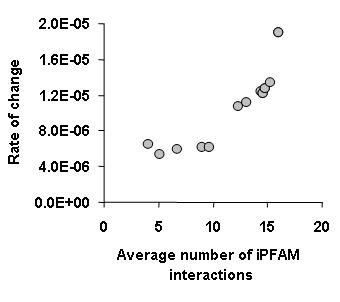
- Protein interactions can change at a fast rate of 1E-5 interactions per protein pair per million years
- Binding specificity is a strong determining of binding specificity with more promiscuous binding proteins having a higher rate of change of interactions.
- Human proteins involved in immune response, transport and establishment of localization, show signs of positive selection for change of interactions.

The making of
We had been using comparative genomics to search for conserved putative protein binding sites. These very conserved putative target sites were very likely to be experimentally known target sites but many other known binding sites seamed not to be so conserved. This was what got us started thinking about the evolution of these protein interactions and what might determine the rate at which interactions are gained and lost during evolution. The analysis was mostly inspired on the nice work of Andreas Wagner that first proposed a rate for the addition of new interactions in S. cerevisiae. We have tried to build on this by analyzing different species and determining also what protein properties might determine the rate at which interactions are gained and lost in evolution.

More than nodes and edges
One of the main conclusions from this work was that binding specificity also determines the rate of change of interactions during evolution. More promiscuous binding proteins not only have many binding partners but they also tend to change partners faster during evolution. To establish a proxy for binding specificity we have used structural information from the iPFAM database. In essence we have considered that protein domains that have been seen in contact with many different other domains would be more promiscuous. In general we observed that proteins containing these promiscuous domains had a high rate of change of interactions (see figure below).

This highlights something that I had stressed before, that it is important to consider protein interaction networks as more than nodes and edges. Another recent paper has also shown that it is possible and useful to use the accumulating structural information available in the PDB to obtain a more accurate representation of protein interaction networks. Philip M. Kim and co workers from the Gerstein lab (blog, webpage) published a study in Science were they have used also the iPFAM database to curate all the S. cerevisie interactions and to discriminate between interactions that use the same or different binding interfaces. With this information the authors distinguish between hubs that tend to interact with their partners mostly trough one interface or trough many interfaces. They have shown that the multi interface hubs are more restricted in evolution and more likely to be essential than single interface hubs. They have a website with presentations and additional data for this paper.

In the pipeline
To be submitted soon (hopefully), are some collaborations on how to use structural information to predict protein-protein binding specificity. With these collaborations I finish my thesis (still waiting for the defense). During the next couple of months I am off to search for a lab to work as a postdoc.

Monday, December 25, 2006

Publish your GreaseMonkey scripts

I knew it was possible to use GreaseMonkey scripts to change webpages to better suit our needs. I tried it once to get blog comments about scientific papers to show up in journal websites. Pierre and Stew have been creating several interesting scripts for postgenomic and connotea. What I did not know was that one could actually publish these scripts. I am all for publishing of smaller and finner grained scientific content but I have to say that this paper seemed like little more than a big blog post. Should we try to publish this type of work ?

Anyway :) ho ho ho , merry xmas everyone

Friday, December 22, 2006

PLoS One is up and running

I will add this blog's "voice" to the many that have already announced the start of PLoS One. This journal is a very much needed experiment in science communication online. It is being built from scratch to take advantage of the internet as the medium unlike many other journals. As Deepak mentioned in his blog, the success of One will depend mostly on us, the users, in our interest to participate with our own insight. The PLoS One team will have to worry about creating interesting reward systems around the journal to help boost participation.

I have only played around on the site for a short while but there are a couple of features that I hope that will implement in the short term.
- One that I was hoping to find at start was some form of gateways or portals for areas. The only subject navigation available seams to be the links on the right side.
- I also did not find any kind of rating system. To boost participation I think people have to start trying out simple participation systems and rating is the easiest one.
- I guess it would also be nice to have some kind of track back system or some other way to let comments come in from blog post. This would be nice for bloggers but i have to admit that few people would care :) .

There were two papers (from the same group) that caught my attention but I did not have time to read them:
Control of Canalization and Evolvability by Hsp90
Modularity and Intrinsic Evolvability of Hsp90-Buffered Change


Tuesday, December 05, 2006

Second (hellish) Life

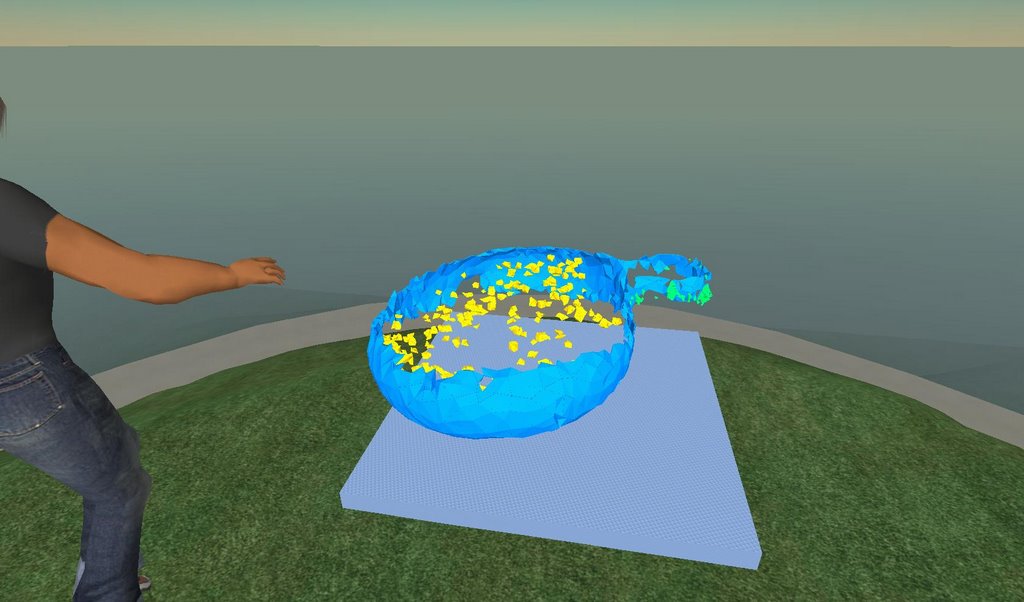
I had a walk around Second Nature inside Second Life. I had tried SL before some months ago and this time the experience was much worse. My avatar keeps freezing when I touch objects or when I stand around idle for some time. Some other times the avatar just freezes in flight and continues in the same direction until I quit. It was just unusable.

Here is a picture from an 3D cell in the Second Nature island.


A feeble attempt to build something for the EMBL online symposium


Monday, December 04, 2006

Modularity and Evolvability

The First Online EMBL PhD Symposium as started today with several media files available for viewing and commenting. There is an IRC channel open for discussion.

Participants can comment or add their own content to the site. I have put up a small presentation relating modularity and evolvability in proteins, language, software and the scientific process. I am no expert in any of these fields so view these analogies with a very critical eye :).

Full screen view can be access from the slideshare site


Saturday, December 02, 2006


The 6th edition of Bio::Blogs is up in Nodalpoint. Many thanks to Greg for setting it up. This edition marks half a year of Bio::Blogs and it is dedicated to conference blogging, probably one of the best examples of the usefulness of science blogging.

The 7th edition will probably be scheduled to February to skip the holiday season and Paras Chopra has volunteered to host it.