Wednesday, May 31, 2006

Bringing democracy to the net

Democracy is most often thought of as in opposition to totalitarianism. In this case I mean democracy in opposition to anarchy. Some people are raising their voices against the trend of collective intelligence/wisdom of the crows that have been the hype of the net for the past few years. Wikipedia is the crown jewel of this trend of empowering people for the common good and probably as a result of the project's visibility it has been the one to take the heat from the backlash.

Is Wikipedia dead like Nicholas Carr suggests in his blog ? His provocative title was a flame bait but he does call attention to some interesting things happening at Wikipedia. The wikipedia is not dead , it is just changing. It has to change to cope with the increase in visibility, vandalism and to deal with situations where no real consensus is possible.
The system is evolving by restricting anonymous posting and allowing editors to apply temporary editing restrictions to some pages. It is evolving to become more bureaucratic in nature with disputes and mechanisms to deal with the discord. What Nicholas Carr said is dead is the ideal that anyone can edit anything in wikipedia and I would say this is actually good news.

Following his post on the death of Wikipedia, Carr points to an assay by Jaron Lanier entitled Digital Maoism. It is a bit long but I highly recommend it.
Some quotes from the text:
"Every authentic example of collective intelligence that I am aware of also shows how that collective was guided or inspired by well-meaning individuals. These people focused the collective and in some cases also corrected for some of the common hive mind failure modes. The balancing of influence between people and collectives is the heart of the design of democracies, scientific communities, and many other long-standing projects. "


Sites like Wikipedia are important online experiments. They are trying to develop the tools that allow useful work to come out from millions of very small contributions. I think this will have to go trough some representative democracy systems. We still have to work on ways to establish the governing body in these internet systems. Essentially to whom we decide to deposit trust for that particular task or realm of knowledge. For this we will need better ways to define identity online and to establish trust relationships.

Further reading:
Wiki-truth

Friday, May 26, 2006

The Human Puppet (2)

In November I rambled about a possible sci-fi scenario. It was about a human person giving away their will to be directed by the masses in the internet. A vessel for the "collective intelligence". A voluntary and extreme reality show.

Well, there goes the sci-fi, you can participate in it in about 19 days. Via TechCrunch I found this site:

Kieran Vogel will make Internet television history when he becomes the first person to give total control of his life to the Internet.
(...)
Through an interactive media platform Kieran will live by the decisions the internet decides such as:

# What time he wakes up
# What he wears
# What he eats
# Who he dates
# What he watches


I get a visceral negative response to this. Although this is just a reality show and it is all going to happen inside a house I think it will be important to keep this in mind. In the future technology will make web even more pervasive then today and there are scenarios along the lines of this human puppet idea that could have negative consequences.
I guess what I am thinking is that the same technologies that helps us to collaborate can also be use to control (sounds a bit obvious). In the end the only difference is on how much do the people involved want to (or can) exercise their will power.

Thursday, May 25, 2006

Using viral memes to request computer time

Every time we direct the browser somewhere, dedicating your attention, some computer processing time is used to display the page. This includes a lot of client side processing like all the javascript in all that nice looking AJAX stuff. What if we could harvest some of this computer processing power to solve very small tasks, something like grid computing.
How would this work ? There could be a video server that would allow me to put a video on my blog (like google video) or a simple game or whatever thing that people would enjoy and spend a little time doing. During this time there would be a package downloaded from the same server, some processing done on the client side and a result sent back. If people enjoy the video/game/whatever and it goes viral then it spreads all over the blogs and any person dedicating their attention to it is contributing computer power to solve some task. Maybe this could work as an alternative to advertising ? Good content would be traded for computer power. To compare, Sun is selling computer power in the US for 1 dollar an hour. Of course this type of very small scale grid processing would be worth much less.

Tags: , ,

Wednesday, May 24, 2006

Conference blogging and SB2.0

In case you missed the Synthetic Biology 2.0 meeting and want a quick summary of what happened there you can take a look at some blogs. There were at least 4 bloggers at the conference. Oliver Morton (chief news and features editor of Nature) has a series of posts in his old blog. Rob Carlson described how he and Drew Endy were calling the field intentional biology. Alex Mallet from Drew Endy's lab has a quick summary of the meeting and finally Mackenzie has in his cis-action by far the best coverage with lots more to read.

I hope they put up on the site the recorded talks since I missed a lot of interesting things during the live webcast.

In the third day of the meeting (that was not available in the live webcast) there was a discussion about possible self-regulation in the field (as in the 1975 Asilomar meeting). According to an article in NewScientist the attending researchers decided against self-regulation measures.


Saturday, May 20, 2006

Synthetic Biology & best practices

There is a Synthetic Biology conference going on in Berkeley (webcast here) and they are going to talk about the subject of best practices in one of the days. There is a document online with an outline of some of the subjects up for discussion. In reaction to this, a group of organization published an open letter for the people attending the meeting.
From the text:
We are writing to express our deep concerns about the rapidly developing field of Synthetic Biology that is attempting to create novel life forms and artificial living systems. We believe that this potentially powerful technology is being developed without proper societal debate concerning socio-economic, security, health, environmental and human rights implications. We are alarmed that synthetic biologists meeting this weekend intend to vote on a scheme of voluntary self-regulation without consulting or involving broader social groups. We urge you to withdraw these self-governance proposals and participate in a process of open and inclusive oversight of this technology.

Forms of self-regulation are not incompatible with open discussion with the broader society nor with state regulation. Do we even need regulation at this point ?


The internet and the study of human intelligence

I started reading a book on machine learning methods last night and my mind floated away to thinking about the internet and artificial intelligence (yes the book is a bit boring :).
Anyway, one thing that I thought about was how the internet might become (or is already) a very good place to study (human) intelligence. Some people are very transparent on the net and if anything the trend is for people to start sharing their lives or at least their view of the world earlier. So it is possible to get an idea of what someone is exposed to, what people read, films they see, some of their life experiences, etc. In some sense you can access someone's input in life.
On the other hand you can also read this person's opinions when presented with some content. Person X with known past experiences Y was exposed to Z and reacted in this way. With this information we could probably learn a lot about human thought processes.


A little bit of this a little bit of that ...

What do you get when you mix humans/sex/religion/evolution? A big media hype.
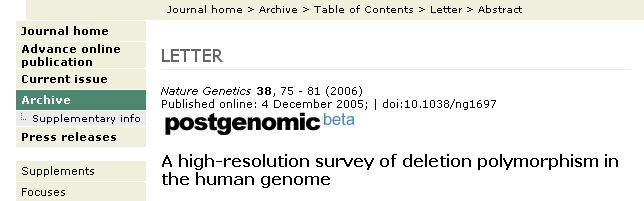
Also, given that a big portion of the scientist currently blogging are working on evolution you also get a lot of buzzing in the science blogosphere. No wonder then why this paper reached the top spot in postgenomic.

This one is a very good example of the usefulness of blogs and why we should really promote more science communication online. The paper was released in advanced online publication and some days after you can already read a lot of opinions about it. It is not just the blog entries but also all the comments on these blog posts. As a result of this we not only get the results and discussion from the paper but the opinion of whoever decided to participate in the discussion.

Wednesday, May 17, 2006

Postgenomic greasemonkey script (2)

I have posted the Postgenomic script I mentioned in the previous post in the Nodalpoint wiki page. There are some instructions there on how to get it running. If you have some problems or suggestions leave some comments here or in the forum in Nodalpoint. Right now it is only set to work with the Nature journals but it should work with more.


Saturday, May 13, 2006

Postgenomics script for Firefox

I am playing around with greasemonkey to try to add links to Postgenomic to journal websites. The basic idea is to search the webpage you are seeing (like a Nature website for example) for papers that have been talked about in blogs and are tracked by Postgenomic. When one is found a little picture is added with a link to the Postgenomic page talking about the paper.
The result is something like this (in the case of the table of contents):


Or like this when viewing the paper itself:


In another journal:


I am more comfortable with Perl, but anyway I think it works as a proof or principle. If Stew agrees I'll probably post the script in Nodalpoint for people to improve or just try it out.

Thursday, May 11, 2006

Google Trends and Co-Op

There some new Google services up and running and buzzing around the blogs today. I only briefly took a look around them.
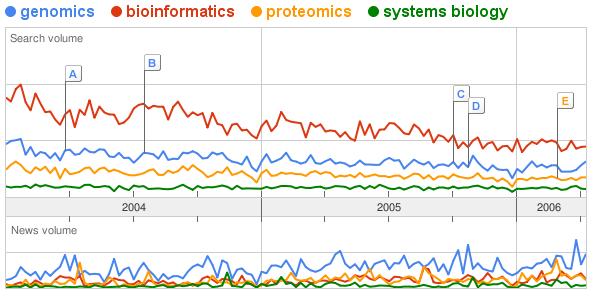
Google Trends is like Google Finance for anything search trend than you want to analyze. Very useful for someone wanting to waste time instead of doing some productive work ;). You can compare the search and news volume for different terms like:

It gets the data from all the google searches so it really does not reflect the trends within the scientific community.

The other new tool out yesterday is Google Co-Op, the start of social search for Google. It looks as obscure as Google Base so I can again try to make some weird connection to how researcher might use it :). It looks like Google Co-Op is a way for users to further personalize their search. User can subscribe to providers that offer their knowledge/guidance to shape some of the results you see in your search. If you search for example for alzheimer's you should see on the top of the results some refinement that you can do. For example you can look only at treatment related results. This was possible because a list of contributors have labeled a lot of content according to some rules.

Anyone can create a directory and start labeling content following an XML schema that describes the "context". So anyone or (more likely) any group of people can add metadata to content and have it available in google. The obvious application for science would be to have metadata on scientific publications available. Maybe getting Connotea and CiteULike data into a google directory for example would be useful. These sites can still go on developing the niche specific tools but we could benefit from having a lot of the tagging metadata available in google.


Wednesday, May 10, 2006

Nature Protocols

Nature continues clearly the most innovative of the publishing houses in my view. A new web site is up in beta phase called Nature Protocols:

Nature Protocols is a new online web resource for laboratory protocols. The site, currently in beta phase, will contain high quality, peer-reviewed protocols commissioned by the Nature Protocols Editorial team and will also publish content posted onto the site by the community

They accept different types of content:
* Peer-reviewed protocols
* Protocols related to primary research papers in Nature journals
* Company Protocols and Application notes
* Non peer-reviewed (Community) protocols

There are already several protocol websites already out there so what is the point ? For Nature I guess it is obvious. Just like most portal websites they are creating a very good place to put ads. I am sure that all these protocols will have links to products on their Nature products and a lot of ads. The second advantage for Nature is the stickiness of the service. More people will come back to the website to look for protocols and stumble on to Nature content, increasing visibility for the journals and their impact.

A little detail is that, as they say above, the protocols from the papers published in the Nature journals will be made available on the website. On one hand this sounds great because the methods sections in the papers are usually so small (due to restrictions for publication) that they are most of the times incredibly hard to decipher (and usually put into supplementary materials). On the other hand, this will increase even further the tendency to hide away from the paper the really important pars of the research, the results and how these where obtained (methods) and to show only the subjective interpretations of the authors.
This reminds me of a recent editorial by Gregory A Petsko in Genome Biology (sub only). Here is how is states the problem :) - "The tendency to marginalize the methods is threatening to turn papers in journals like Nature and Science into glorified press releases."

For scientists this will be a very useful resource. Nature has a lot of appeal and will be able to quickly create a lot of really good content by inviting experienced scientists to write up their protocols full with tips and tricks accumulated over years of experience. This is the easy part for science portals, the content comes free. If somebody went to Yahoo and told them that scientist actually pay scientific journals to please please show our created content they would probably laugh :). Yahoo/MSN and other web portals have to pay people to create the content that they have on their sites.

web2.0@EMBL

The EMBL Centre for Computational Biology has announced a series of talks related to novel concepts and easy-to-use web tools for biologists. So far there are three schedule talks:

Session 1 - Using new web concepts for more efficient research - an introduction for the less-techy crowd
Time/place: Tue, May 16th, 2006; 14:30; Small Operon

This one I think will introduce the concepts around what is called web2.0 and the potential impact these might have for researchers. I am really curious to see how big will the "less-techy crowd" really be :).

The following sessions are a bit more specific dealing with particular problems we might have in our activities and how can some of the recent web technologies help us deal with them.

Session 2 - Information overflow? Stay tuned with a click (May 23rd, 2006; 14:30;)
Session 3 - Tags: simply organize and share links and references with keywords (May 30th, 2006; 14:30)
Session 4 - Stop emailing huge files: How to jointly edit manuscripts and share data (June 6th, 2006; 14:30;)
All in the Small Operon, here in the EMBL Heidelberg

I commend the efforts of the EMBL CCB and I hope that a lot of people turn up. Let's see if the open collaborative ideas come up on the discussions. If you are in the neighborhood and are interested, come on by and help with the discussion (map).

Tags: ,